It Was Never the Magnesium. It Was the Form.
Why so many women decide “magnesium just doesn’t work for me” — and the 10-second label test that shows whether yours ever had a chance.


There’s a drawer in your kitchen.
Or a shelf. Or the back of the bathroom cabinet.
In it is the magnesium you bought when a friend swore by it. The big bottle from the pharmacy that was on offer. The powder you mixed twice and then forgot about. The “calm” tablets that did nothing except send you to the bathroom.
Every one of those bottles was a small act of hope.
Hope that tonight you’d sleep past 3am. That your legs would finally settle. That the hum in your chest would switch off. That tomorrow you’d have the patience you used to have with the people you love.
And every one of them ended the same way. Half full. Pushed to the back. And a quiet conclusion forming in your head:
“Maybe magnesium just doesn’t work for me.”
You’re far from the only one. On one magnesium forum, a woman wrote:
“I’ve tried literally every form of magnesium over a two year period.”
Another summed up what everyone seems to feel:
“there’s so much conflicting info.”
So before you write magnesium off for good, let me show you something almost nobody is told. It takes about ten seconds to check, and it might explain every one of those bottles.
Magnesium Never Travels Alone
Here’s the part the front of the bottle never mentions.
Magnesium is never in a supplement on its own. It’s always bonded to a partner molecule: oxide, citrate, glycinate and so on.
Think of it like a letter and its envelope.
The magnesium is the letter. The partner is the envelope.

And the envelope decides three things:
1. Whether the letter gets delivered at all. How much your body actually absorbs.
2. What happens on the way. Gentle on your gut, or a 2am sprint to the bathroom.
3. Whether anything useful arrives with it. Some partners are just packaging. Some bring something of their own.
Same mineral. Completely different results.
So when magnesium “didn’t work”, the honest question isn’t “Does magnesium work for me?”
It’s: “Which envelope was I sent?”
The 10-Second Label Test
Find the nearest magnesium supplement: the one in your drawer, or the one sitting in your online basket right now.
Step 1. Ignore the front.
“High Absorption.” “Advanced Formula.” “Calm Complex.” None of those are measurements. They’re marketing.
Step 2. Turn it over and find the Supplement Facts panel.
Step 3. Look at the word in brackets right after “Magnesium.”
That’s the envelope. Now find it below.

🔴 “(as magnesium oxide)”
The most common form on the shelf, and one of the most poorly absorbed. In one well-known study, only about 4% was absorbed. Much of the rest stays in your gut, drawing in water.
🔴 “(as magnesium carbonate)”
Another inexpensive form, and also used as an antacid. It isn’t the form people reach for to wind down at night.
🟠 “(as magnesium citrate)”
Absorbs better than oxide, but it’s also a laxative sold for constipation. Useful if that’s your goal. Less useful at 10pm.
🟠 “Magnesium complex”, “blend”, or a list of forms with no amounts
If the label doesn’t say how much of each form you’re getting, you can’t know how much of it is the cheap one.
🟠 “Glycinate buffered with magnesium oxide”
Glycinate on the front, oxide mixed in behind it. Read the whole bracket, not just the first word.
🟡 “(as magnesium malate)” or “(as magnesium L-threonate)”
Genuine forms with their own uses. Malate is popular as a daytime form, and threonate is newer, pricier and studied mostly for the brain. Neither is a bad choice. They’re just not the one women on sleep forums mention most.
🟢 “(as magnesium bisglycinate)” or “glycinate chelate”
This is the one to look for. More on why in a moment.
So, what did yours say?
If it was red or orange, that alone may explain a lot.
“Liquid Dynamite” (and Other Things Nobody Warns You About)
If you’ve ever taken the wrong form, you probably don’t need a study. Your stomach already told you.
On the forums, one woman’s name for magnesium citrate has become a bit of a legend: “liquid dynamite.”
Others are less poetic:
“citrate gave me cramps”
“Severe nausea, vomiting and diarrhea after taking this for the first time.”
There’s a special kind of betrayal in taking something to help you sleep and spending 2am on the bathroom floor instead.
A forum moderator put the fix bluntly:
“Just don’t use magnesium oxide, and you’re probably golden.”
But the bathroom isn’t the most common outcome.
The most common outcome is nothing.
No side effects. No change. You take it faithfully for a month, feel exactly the same, and quietly decide the problem must be you.
So Why Is the Worst-Absorbed Form Everywhere?

Walk down any pharmacy aisle and you’ll often find oxide.
It’s not a conspiracy. It’s just maths.
Oxide is cheap to produce. It’s dense, so a lot of it fits into a small tablet. It’s stable, easy to manufacture and easy to price low.
What it isn’t is well absorbed.
The better-absorbed forms cost more to make and take up more room. So fewer products use them, and the ones that do usually cost more.
This isn’t about which companies are good or bad. Plenty of well-meaning brands sell oxide. It’s about the one thing the front of the bottle won’t tell you, and the back of it will.
You Didn’t Fail Magnesium. You Never Really Tried It.
If you’ve been through three, four, five magnesiums and felt nothing, it’s easy to decide the problem is you.
That your body is “just weird.” That you’re simply an anxious person. A bad sleeper. That this is “just how you are” now.
But look at what you actually tried.
If the bracket said oxide, carbonate, citrate or “complex,” you never actually tested the form the forums rave about.
You tested the envelope.
One woman on a health forum realised it the way most of us do, after the money was already spent:
“I had already bought some magnesium oxide when apparently what I need is [another form]… we live and learn!”
We do live and learn. The good news is that this particular lesson is cheap to act on.
(And if a doctor ever told you your magnesium levels were “normal”: less than 1% of your body’s magnesium is in your blood, so a standard blood test doesn’t tell the whole story. That’s a whole article of its own.)
So what should be in that bracket?
The form women keep switching to after everything else let them down. The one with the gentlest reputation on the forums. The one where the envelope isn’t just packaging, because it brings something of its own.
It’s called bisglycinate.
And the envelope it comes in is the most interesting part…
The Envelope That Brings Something of Its Own
Remember the letter and the envelope?
With most forms, the envelope is just packaging. At best it gets out of the way. At worst it sends you to the bathroom.
Bisglycinate is different.
“Bis” means two. “Glycinate” means glycine. Each magnesium is bonded (the technical word is chelated) to two molecules of glycine, a small amino acid your body already uses every day.
(You’ll see it written as “magnesium glycinate,” “bisglycinate” or “glycinate chelate.” On a label, they’re describing the same thing.)
That envelope changes the whole journey.

It’s delivered through a second door.
Loose, cheap forms break apart in your gut and compete for the same crowded route in, and much of them never make it. Research suggests chelated magnesium can also be absorbed through the pathways your body uses for amino acids. So it isn’t stuck queuing at one jammed door.
It arrives gently.
It doesn’t sit in your gut pulling in water the way oxide does, and it isn’t a laxative the way citrate is. That’s why bisglycinate has the gentlest reputation of any form on the forums. One reviewer called it “notably gentle on the stomach.”
And the envelope brings something of its own.
Glycine isn’t just packaging. It’s an amino acid your nervous system uses as one of its own natural calming signals.
So the letter is magnesium, the mineral your “off switch” depends on. And the envelope is a molecule your body already uses to settle itself down.
Same team. One delivery.
That’s why this is the form women keep switching to once they’ve learned the label test:
“citrate gave me cramps but glycinate works best.”
“no stomach issues like with citrate and my sleep feels smoother.”
“Glycinate helps in staying asleep.”
One honest note, because you deserve the full picture. A small number of people find glycinate a little energising rather than calming. If that turns out to be you, don’t write it off. Take it earlier in the evening, with dinner instead of at lights-out. Most brands would never mention it. I’d rather you know before you start than give up on night two.
The Label Test Has a Second Question
So you’ve found the right envelope. Good.
But there’s a second reason magnesium “didn’t work” for so many women, and it has nothing to do with chemistry.
It stayed in the drawer.
The tablets the size of a horse pill that catch halfway down. The chalky powder you have to remember to mix. The capsules with mystery fillers. One woman on the forums broke out in a rash from rice-hull capsule fillers, describing “fissures in my skin.”

Here’s the thing most people don’t realise about magnesium.
It isn’t a sleeping pill that knocks you out for a night. It’s a mineral you’ve likely been running low on for years. Topping it back up takes consistency: night after night, week after week.
Which means the second question on the label test is simply:
“Will I actually take this every single night?”
The best magnesium in the world does nothing in the drawer.
And the “stronger” one you skip three nights a week will lose to the gentler one you never miss.
Before You Buy Another Bottle, Check All Six
Here’s the full test. Use it on anything you’re considering, including the next bottle that catches your eye.
✅ Green in the bracket. Bisglycinate, with nothing “buffered” hiding behind it.
✅ No melatonin. You want to wake up rested, not groggy, and not relying on a hormone to fall asleep.
✅ Zero sugar. It’s the last thing you’ll put in your body before bed.
✅ A short ingredient list you can actually read. No fillers, no artificial colours or flavours.
✅ Third-party tested, so someone other than the brand has checked what’s inside.
✅ Something you’ll look forward to taking, not another chore you’ll quietly abandon.
Most magnesium on the shelf fails the very first check.
Here’s one that passes all six.
Naturia Magnesium Bisglycinate Gummies
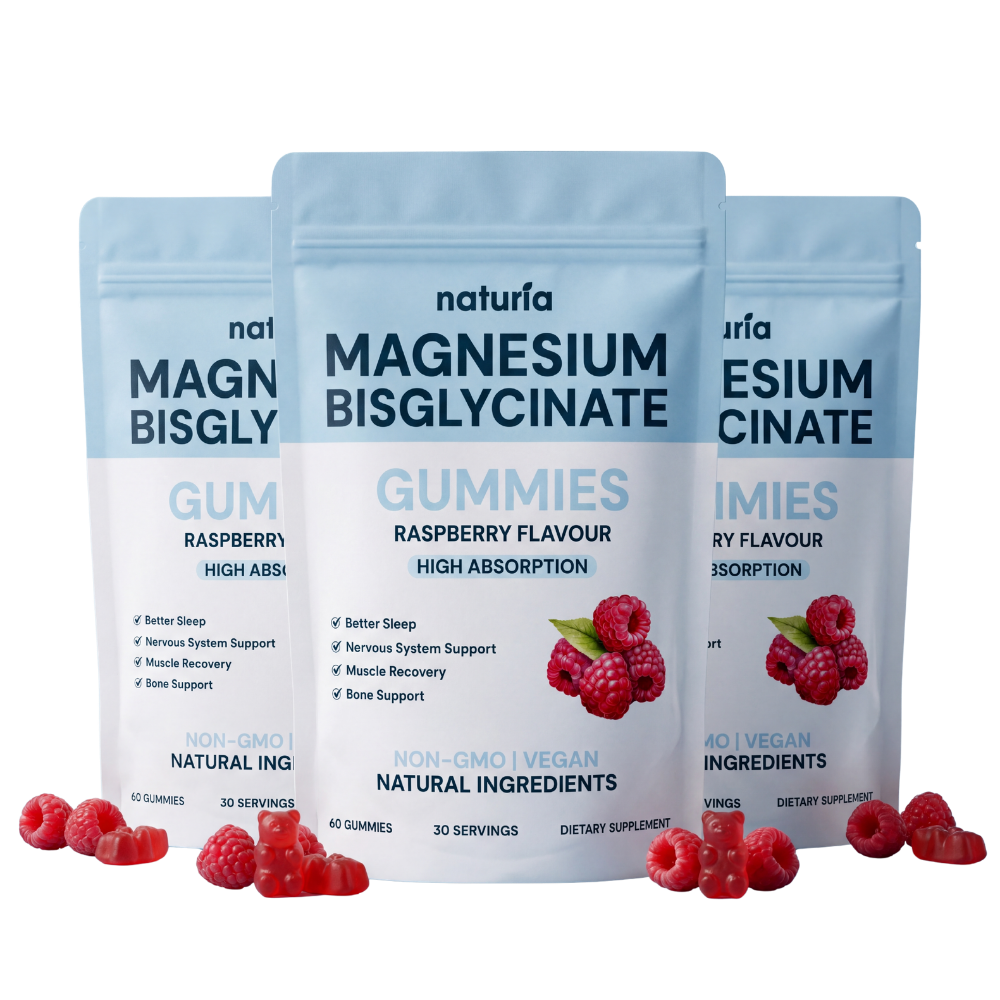
Turn a pouch of Naturia over and look in the bracket.
Magnesium bisglycinate chelate. Green. No oxide. No citrate. No buffering.
Then it passes the rest:
✅ Two raspberry gummies, 30 minutes before bed. That’s the whole routine. Made with real raspberry fruit powder, so it feels like a small treat at the end of the day, not a chore.
✅ 0g sugar
✅ No melatonin. No 7am fog. Nothing to become dependent on.
✅ No artificial colours or flavours, no fillers
✅ Vegan (pectin, not gelatin) and non-GMO
✅ Third-party tested
✅ Made in the USA
No horse pills. No powder to mix. No bathroom surprises.
Just the right envelope, in a form you’ll actually reach for.
And one more thing you can check for yourself:
127 clinicians have shared Naturia on FrontrowMD, without being paid to.
What to Expect (Without the Overnight Miracle)
You’ve been promised overnight miracles before. Every bottle in that drawer came with one.
So here’s what many Naturia customers describe instead:

Night 1 → You feel calmer, more ready to sleep.
The edge comes off. The hum starts to quieten.
Week 2 → Your nights improve.
More restful sleep. Fewer 3am wake-ups. Less of that wired-but-tired feeling at bedtime.
Day 30+ → Your days improve.
More energy, a clearer head, a steadier mood.
Why does it build like this? Because you’re not sedating yourself. You’re finally refilling something with a form your body can actually use.
In Naturia’s own customer feedback, after the first two weeks of taking it nightly:
82% said they fell asleep faster
73% felt calmer and more relaxed at bedtime
88% woke up feeling more rested
†Based on self-reported feedback from Naturia customers. Individual results vary.
“After Years and Years of Broken Sleep…”
Mark has been taking the right form for more than six months now:

“I’ve been taking magnesium bisglycinate for over 6 months now. After years and years of broken sleep, I’m finally sleeping through most nights. Highly recommend.”
For Ashley, it wasn’t one night that changed things. It was sticking with it:

“I found my Zen.”
“I found myself always feeling wired, I had no off switch. I was consistent with magnesium and over time these symptoms faded. Sleep has improved. It’s a routine now.”
It’s a routine now. That’s the second label-test question, answered.
The Cheap Bottle Is the Expensive One
Let’s talk about money, because you’ve already spent plenty.
Add up the bottles in that drawer. The melatonin. The powder. The “calm” tablets. The one that was on offer.
Every one of them was cheap. Together, they probably weren’t.
And not one of them worked.

Naturia is under $2 a night at full price, and less than that with the 3-pouch option in the Fall Sale.
That’s less than the coffee you need to get through the morning after a bad night.
The real cost was never the price of a bottle. It was every night you lay awake at 3am, and every morning you weren’t yourself.
Try It for 90 Days. Keep the Pouch Either Way.

You’ve taken a chance on a lot of bottles. None of them ever offered to take the risk off you.
This one does.
Take two Naturia gummies every night. If you’re not happy with them for any reason, email the Naturia team within 90 days and they’ll refund you in full.
You don’t need to send the pouch back.
So there’s only one thing left to lose: another night like last night.
Which Option Makes Sense?
Magnesium builds. Many of the biggest changes show up after day 30.
That’s why most women choose the 3-pouch option. It’s a full 90 days of nightly support, the same length as the guarantee. Stopping just as it starts to work makes no sense.
With 3 pouches right now, you also get:
🎁 A FREE sleep mask
🍂 Naturia’s Fall Sale: up to 30% off
One More Bottle for the Drawer, or the Last Label Test You Need
Option 1: You close this page.
Tonight, nothing changes.
Next week you’re in the pharmacy aisle again, looking at a wall of bottles that all say “High Absorption” on the front. You pick one. It joins the others in the drawer.
And at 3am, you’re awake, wondering what’s wrong with you.
Option 2: You check the Fall Sale price.
A pouch of raspberry gummies arrives at your door.
You turn it over, out of habit now, and there it is in the bracket: bisglycinate chelate.
You take two, thirty minutes before bed.
That first night, you notice the edge come off. A couple of weeks in, you realise 3am has stopped being a nightly appointment. A month from now, it’s just a routine, one you actually look forward to.
And if none of that happens, you get every cent back and keep the pouch.
Magnesium never failed you.
You just hadn’t been sent the right envelope.
P.S. If you skimmed to the bottom, here’s the whole article in five lines:
1. If magnesium “did nothing” or wrecked your stomach, check the bracket on the back. It was probably oxide, carbonate, citrate or an unlabelled “complex.”
2. The form decides how much you absorb and how your gut reacts. Same mineral, very different results.
3. Bisglycinate is magnesium bonded to glycine: gentle, well-absorbed, and glycine is a calming signal your body already uses.
4. The best magnesium is the one you’ll actually take every night. Naturia is two sugar-free raspberry gummies, with no melatonin and no horse pills.
5. It’s backed by a 90-day money-back guarantee, and you keep the pouch either way.
ADVERTORIAL. This article is paid content from Naturia. *These statements have not been evaluated by the Food and Drug Administration. This product is not intended to diagnose, treat, cure or prevent any disease. †Customer statistics are based on self-reported feedback from Naturia customers. Testimonials reflect individual experiences; results vary. Forum and WebMD quotes describe experiences with magnesium in general, not Naturia. Guarantee: one refund per customer or household, within 90 days of delivery; see our refund policy. Consult your doctor before use if you are pregnant or nursing, have kidney disease, or take prescription medication.
Sources: Firoz & Graber, Magnes Res 2001 · US NIH Office of Dietary Supplements, Magnesium fact sheet · Int. J. Vitam. Nutr. Res. (2024–25).